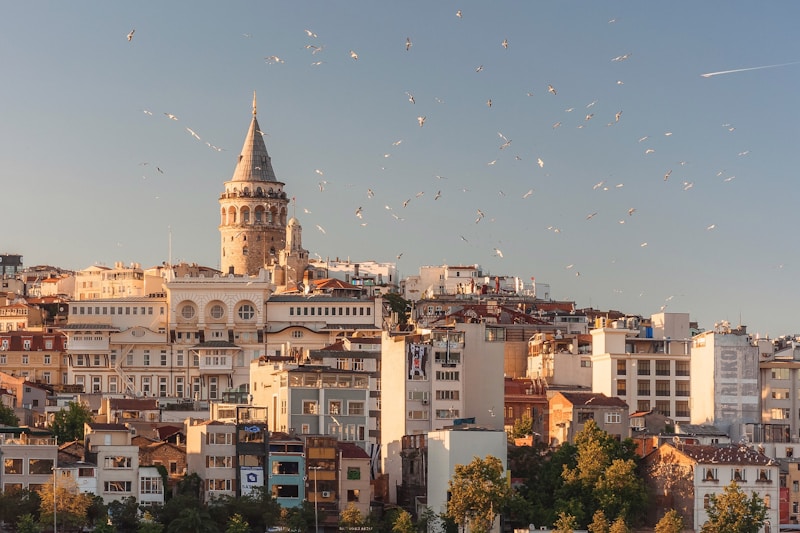
Best Time to Visit Datça: Month-by-Month Guide, Beaches & Airport Transfer
Datça is the long, mountainous peninsula in south-west Turkey that reaches out to the point where the Aegean meets the Mediterranean — a deliberately unspoiled, bohemian alternative to the big resorts. This is a place of clean air and clear water, almond groves, the ancient city of Knidos at its very tip, the pretty stone village of Old Datça, and a string of quiet south-facing coves. It is also one of Turkey's great sailing and blue-cruise bases. There is no airport on the peninsula, so most visitors arrive by a private transfer from Dalaman Airport (~165 km, about 2.5 hours), or by the seasonal Bodrum–Datça ferry. Because the season runs long and the wind keeps summers comfortable, the best time to visit Datça depends on what you want — sailing and warm sea, quiet beaches, the famous almond blossom, or the lowest prices of the year.
Quick answer
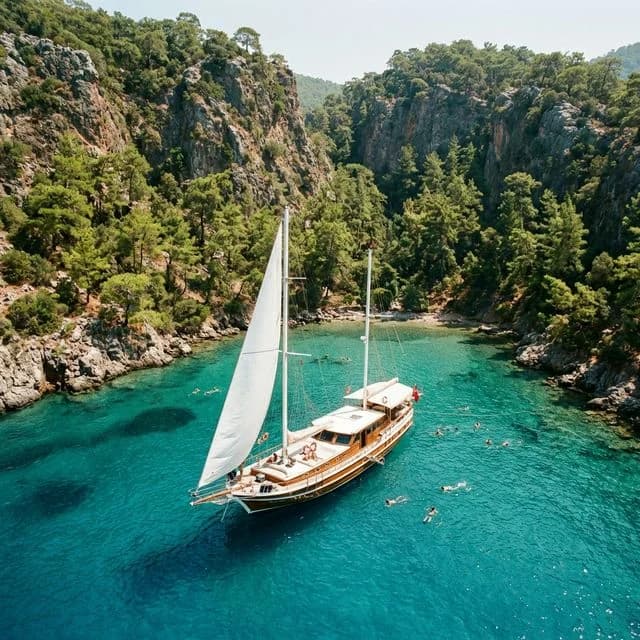
Blue-cruise sailing yachts off the Datça peninsula where the Aegean meets the Mediterranean
- Best all-round: late May to June, and September to early October — warm sea, gentle heat, sea breezes, fewer crowds.
- Best for sailing & blue cruises: June to September, with reliable wind and warm water.
- Best for the almond blossom: mid-February to March.
- Cheapest and quietest: November to March.
Datça weather month by month
| Month | Air (°C) | Sea (°C) | Rain | Crowds |
|---|---|---|---|---|
| Apr | 19 | 17 | Light | Low |
| May | 24 | 19 | Rare | Moderate |
| Jun | 28 | 23 | Dry | High |
| Jul | 31 | 25 | Dry | Peak |
| Aug | 32 | 26 | Dry | Peak |
| Sep | 29 | 25 | Dry | High |
| Oct | 25 | 23 | Light | Moderate |
| Nov | 20 | 21 | Wet | Low |
Spring in Datça (April–May)
Spring is arguably Datça's loveliest season. Days warm to a pleasant 19–24°C, the hills are green, and the peninsula is quiet and well-priced. The sea is still cool early on (17°C in April) but reaches a swimmable 19–20°C by late May. It is the ideal window for hiking the Carian Trail, exploring Knidos and Old Datça before the heat, and walking the coves in peace. If you come in late February or March, you catch the celebrated almond blossom, when the whole peninsula turns pink and white. Best for walkers, couples, nature lovers and value-seeking families before the school holidays.
Summer in Datça (June–August)
High summer is hot, dry and dependable: 28–32°C, near-zero rain, and a warm, clear sea (23–26°C). Thanks to the meltem wind it rarely feels oppressive, and the same breeze makes this the peak season for sailing, gulet cruises and windsurfing. The town harbour and the southern bükü coves are at their liveliest, though Datça stays calmer and more grown-up than Bodrum or Marmaris. It is the most expensive period and the busiest time for transfers and the Bodrum ferry, so book your airport transfer and any boat trip ahead. Beat the midday heat with early and late beach time.
Planning your trip?
Book your private airport transfer now and save up to 50% compared to regular taxis.
Autumn in Datça (September–October)
For many travellers this is the sweet spot. The sea holds its summer warmth (23–25°C) while the air eases to a comfortable 25–29°C, crowds thin and prices fall. September still feels like full summer for swimming and sailing; October turns mild and golden, ideal for the coves, Knidos and the Carian Trail. The light is beautiful and the harbour stays pleasant well into autumn. Excellent for sailors, couples and families travelling after the peak.
Winter in Datça (November–March)
Winters are mild but quiet and variable, with daytime highs of 14–20°C and the rainiest stretch of the year (wettest December–January). The sea cools to around 17–18°C — too chilly for most swimmers — and many small hotels, beach restaurants and boat operators close. But this is the cheapest time by far, the air is crystal-clear, and it is wonderful for walking and for catching the almond blossom from mid-February. If you come in winter, confirm in advance that your hotel and a few restaurants stay open, and pack a light jacket and a rain layer.
Datça month-by-month at a glance
- February–March — almond blossom, cool and quiet, lowest prices; great for walking and photos.
- April — green, mild, cheap; cool sea, ideal for Knidos and the Carian Trail.
- May — warming up, sea swimmable late month, lovely value.
- June — warm sea, reliable sailing wind, lively but not packed; excellent all-round.
- July — peak heat and crowds, best sailing, busiest transfers; book early.
- August — peak and busiest; warm sea, breezy, reserve everything ahead.
- September — still summer, warm sea, thinning crowds; a top month.
- October — mild, golden, warm sea early month; superb for walking and beaches.
- November–January — quiet, cooler, wettest; cheapest, many closures.
Best time to visit Datça by type of traveller
- Sailors & blue-cruise guests: June to September for warm water and reliable *meltem* wind; Datça is a classic gulet departure point for the Gulf of Gökova and Hisarönü.
- Couples: May, June, September and October — mild, romantic, quiet harbour and cove dinners, and far better value than the big resorts.
- Families: late June or September — warm calm sea in the southern coves, fewer crowds than peak August.
- Nature lovers & hikers: April–May and October, when the Carian Trail and Knidos are at their best.
- Beach lovers: July–August for the warmest sea and the liveliest *bükü* coves.
- Foodies: late summer through autumn for the almond harvest; February–March for the blossom.
- Budget travellers: November–March for the lowest prices, accepting limited openings.
Planning your trip?
Book your private airport transfer now and save up to 50% compared to regular taxis.
What makes Datça special (and is it worth visiting?)
Yes — if you want the anti-Bodrum. Datça was deliberately protected from mass development, so there are no high-rise resorts, just a low-key town, the restored stone village of Old Datça (long beloved by Turkish artists and writers, including the poet Can Yücel), and unspoiled coves backed by pine and almond. The vibe is bohemian, slow and a little arty — more about sailing, swimming in clear water, long lunches and walks than nightlife. If you are choosing Datça vs Bodrum or Marmaris, pick Datça for nature, calm and authenticity, and the busier resorts for big beaches and party energy.
Knidos and Datça's ancient history
At the very tip of the peninsula, where the two seas meet, stands Knidos — an important ancient Greek-Carian city famous in antiquity for the Aphrodite of Knidos, the first major nude female statue of the classical world. Today you can wander its twin harbours, hillside amphitheatre and temple terraces, with one of the most dramatic sunsets on the Turkish coast. Combined with Old Datça and the windmills above the town, the peninsula rewards anyone interested in history — and the mild shoulder seasons (April–May, October) are perfect for exploring the ruins without the heat.
Datça's best beaches and coves
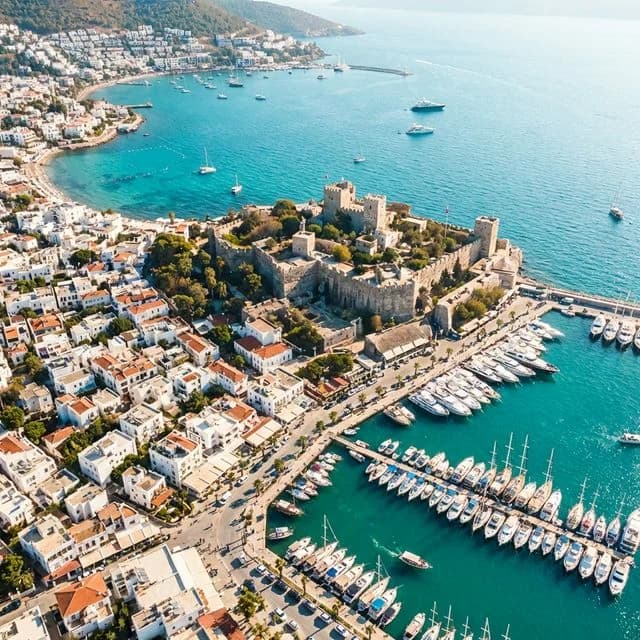
Clear Aegean beaches and coves on the Datça peninsula
Datça is all about small, clean coves — the south-facing bükü bays — rather than long resort beaches. Favourites include Ovabükü, Palamutbükü and Hayıtbükü (clear, calm, with simple fish restaurants on the sand), Kargı and Mesudiye near the town, plus the Kumluk and Taşlık beaches right in Datça centre. The water is exceptionally clear and the coves stay relatively quiet even in summer. A hire car or a private transfer makes the scattered southern bays easy to reach; many are a 20–40 minute drive from the town.
Sailing and blue cruise from Datça
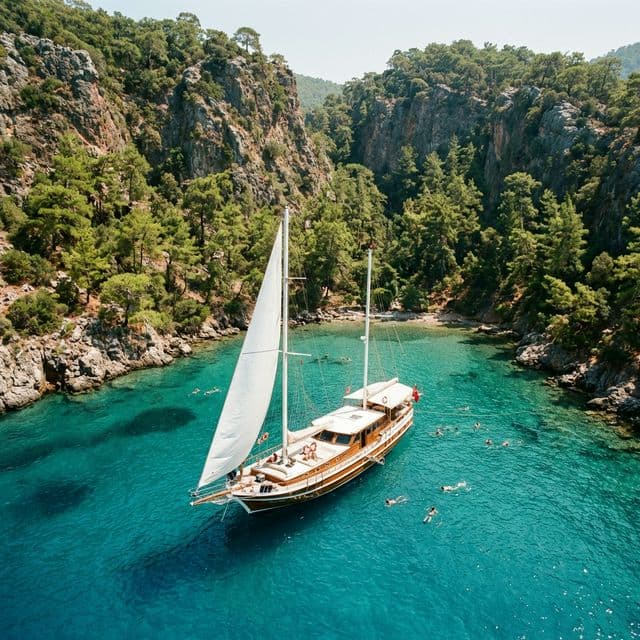
Gulet boat on a blue cruise from the Datça peninsula
Datça is one of Turkey's premier blue-cruise and gulet bases. Its position between the Gulf of Gökova, the Hisarönü Gulf and the Greek Dodecanese makes it a launchpad for some of the Aegean's best sailing, and there are daily and weekly gulet charters, day-boat trips to Knidos by sea, and seasonal ferries to the Greek islands of Symi and Rhodes as well as to Bodrum. The sailing season runs roughly May to October, peaking June to September for warm water and the steady meltem wind. If a specific cruise matters, book it — and your airport transfer to the harbour — in advance.
Planning your trip?
Book your private airport transfer now and save up to 50% compared to regular taxis.
The famous Datça almonds
Datça is renowned across Turkey for its almonds (Datça bademi), a prized local variety grown all over the peninsula. In mid-February to March the almond trees blossom in clouds of pink and white, celebrated with the annual Almond Blossom Festival — a beautiful, quiet time to visit. Through the year you will find Datça almonds everywhere: raw and roasted, in desserts, oils and soaps, and as the perfect edible souvenir. The almond harvest in late summer is part of the peninsula's gentle rural rhythm.
Day trips and things to do around Datça
- Knidos — the ancient city at the tip of the peninsula, by road or boat, best at sunset.
- Old Datça (Eski Datça) — the restored stone village with bougainvillea lanes, boutique cafés and art.
- The southern coves — Ovabükü, Palamutbükü, Hayıtbükü and Mesudiye for swimming and fish lunches.
- The Carian Trail — long-distance walking through pine forest and along the coast.
- Symi & Rhodes — seasonal ferries to the nearby Greek islands for a day abroad.
- Marmaris — the larger resort town about 72 km east, an easy day trip or arrival route.
Events through the year
Datça's calendar is gentle: the Almond Blossom Festival in February–March is the signature event, while summer brings the sailing season, harbour dining and live music. Spring and autumn suit the Carian Trail walking season and quieter sightseeing. The peninsula never feels crowded or commercialised, which is much of its charm. If specific dates matter, book your stay and transfer early, as the small boutique hotels fill quickly in peak summer.
How to get to Datça: airport transfer and ferry
Private Mercedes transfer to Datça from Dalaman Airport
There is no airport on the Datça peninsula, so planning your arrival matters. The most practical option is a private transfer from Dalaman Airport — about 165 km, roughly 2.5 hours, with a WeCare transfer from a fixed €54 per vehicle (Mercedes Vito from €69, Maybach VIP from €79). Alternatively, fly into Bodrum and take the seasonal Bodrum–Datça ferry across the gulf, or arrive via Marmaris, about 72 km east. With a private transfer you are met inside arrivals with a name sign, ride in a modern Mercedes with free child seats on request, and pay on arrival — no meter, no surge, and a rested driver for the long mountain road onto the peninsula. Book your Dalaman → Datça transfer here, or the Marmaris → Datça transfer here.
Planning your trip?
Book your private airport transfer now and save up to 50% compared to regular taxis.
Practical tips by season
- Summer: book your transfer, hotel and any blue cruise early; pack high-SPF sunscreen and a hat, and plan beach time for the morning and late afternoon.
- Spring/Autumn: bring layers for cool evenings, plus proper shoes for the Carian Trail and the Knidos ruins.
- Winter & blossom season: a light waterproof and a jacket; confirm your hotel and a few restaurants stay open, and time a February–March trip for the almond blossom.
Frequently asked questions
When is the best time to visit Datça? Late May–June and September–early October give the best balance of warm sea, gentle heat and sea breezes with manageable crowds. July–August are hottest, busiest and best for sailing; February–March is the almond blossom.
How do I get to Datça? There is no airport on the peninsula. Most visitors take a private transfer from Dalaman Airport (~165 km, ~2.5 hours), the seasonal Bodrum–Datça ferry, or arrive via Marmaris (~72 km).
Which airport is closest to Datça? Dalaman is the most practical by road at about 165 km; Bodrum is closer as the crow flies but is across the gulf and reached by ferry.
How much is a transfer from Dalaman to Datça? A private WeCare transfer is from €54 per vehicle (Mercedes Vito from €69, Maybach VIP from €79), fixed at booking. See the price and book here.
Is there a ferry to Datça? Yes — a seasonal car-and-passenger ferry links Bodrum and Datça across the gulf, plus seasonal ferries to the Greek islands of Symi and Rhodes.
How far is Datça from Marmaris? About 72 km, roughly a 1 hour 20 minute drive east; a private Marmaris → Datça transfer is an easy option.
Is Datça worth visiting? Very, if you want clear water, unspoiled coves, sailing and a calm, bohemian atmosphere rather than big resorts and nightlife — it is often called the anti-Bodrum.
Datça vs Bodrum — which is better? Choose Datça for nature, quiet coves, sailing and authenticity; choose Bodrum for big beaches, marinas, shopping and nightlife. Many sailors combine both via the ferry.
What is Datça famous for? Its almonds (Datça bademi) and almond blossom, the ancient city of Knidos, blue-cruise sailing, clean air and clear water, and the artistic village of Old Datça.
What are the best beaches in Datça? The southern coves — Ovabükü, Palamutbükü, Hayıtbükü and Mesudiye — plus Kumluk and Taşlık in the town centre; all clear, calm and relatively quiet.
When is the almond blossom in Datça? Roughly mid-February to March, celebrated with the Almond Blossom Festival — a quiet, beautiful and very affordable time to visit.
Is Datça good for a blue cruise? Yes — it is a top gulet and sailing base, best from June to September for warm water and the steady meltem wind.
Should I book my transfer in advance? Yes — Datça is a long run from any airport and the peninsula road is mountainous, so a pre-booked, rested driver and a fixed price matter, especially in peak summer.
Planning your trip?
Book your private airport transfer now and save up to 50% compared to regular taxis.